
From Collections to the Field: Building Tanzania’s Next Generation of Biodiversity Scientists

September marked an important milestone for the Hazina Project, bringing together training, fieldwork and collections development to strengthen Tanzania’s capacity to document and understand its extraordinary biodiversity.

Pemba campsite in Mkingu Nature Forest Reserve, Nguru mountains, a station where field training were conducted.
For Hazina, building a natural history collection is about much more than preserving specimens. A collection only becomes truly valuable when people have the skills to curate it, research it, add to it and use it to answer questions about the natural world. That principle shaped an intensive programme of training in September, bringing together University of Dar es Salaam (UDSM) staff, five new Master's students, three new curators and specialists from Tanzania and international partner institutions.

Some members of the university of Dar es salaam staff (Department of Zoology and wildlife conservation), students, curators and international partners composing hazina team
The programme combined classroom teaching and practical collections work in Dar es Salaam with hands-on biodiversity surveys in the Nguru Mountains. Together, these activities provided participants with experience across the full process of biodiversity research — from finding and documenting animals in the field, to collecting and preserving specimens, to building the research questions that can ultimately be answered using museum collections.
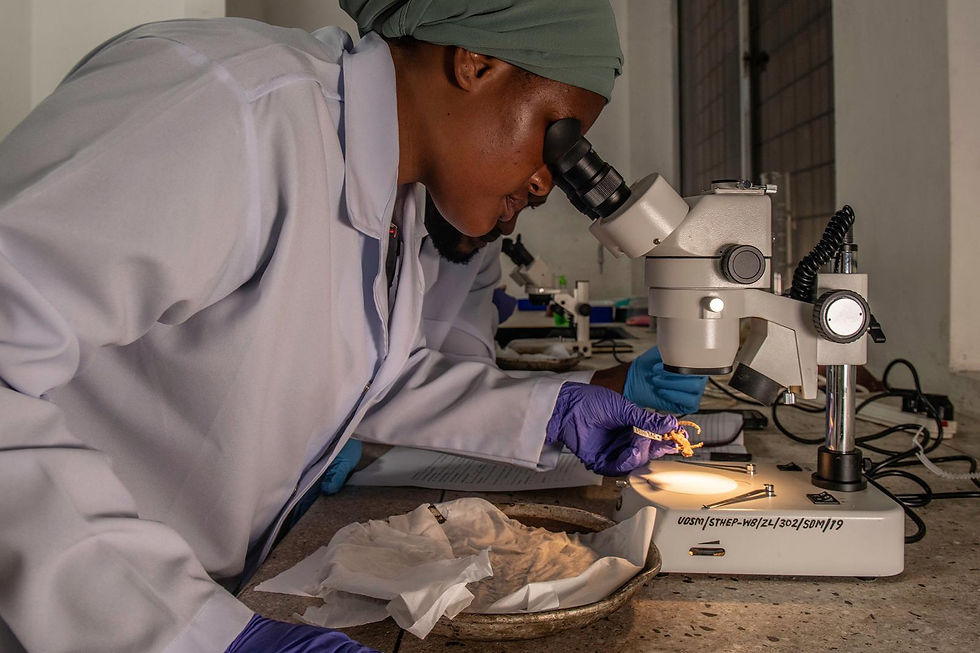
During a practical session, students observing some preserved specimens under microscope.
From the collection room to the forest
The September programme began in Dar es Salaam, where participants worked with specialists in herpetology, fish and mammal collections and research. Training focused not simply on learning techniques, but on understanding why good collections practice matters. Specimens need to be collected responsibly, prepared correctly, documented accurately and preserved so that they remain useful to researchers decades into the future.

Students, curators and their instructors in the session
For the new curators, this provided practical experience relevant to the development of UDSM's zoological collections. For the Master's students, it provided an opportunity to connect collections with their own emerging research interests. The programme then moved from the collection room into the field.
Learning biodiversity survey techniques in the Nguru Mountains
From the collection room to the laboratory
In the Nguru Mountains, participants undertook structured surveys of bats, fish, amphibians and reptiles. Fieldwork provided an opportunity to put survey methods into practice in a real biodiversity-rich environment. Participants learned how systematic field sampling can generate comparable information about species distributions and abundance, while also developing practical skills in finding, identifying, documenting and preserving specimens. This connection between fieldwork and collections is central to Hazina.

Ara monadjem (Holding a sherman trap) a small mammal expert explaining to curators and students on proper use of sherma traps.
A specimen collected in the field is not simply an individual animal. When properly documented and preserved, it becomes a permanent record of where a species occurred, when it was found and what the environment was like at that time. Over many years, collections can therefore become an invaluable record of environmental and biological change. For Tanzania, where many species and habitats remain incompletely documented, developing this capacity is particularly important.

John lyakurwa (in a chair) a reptile and amphibians expert demostrating on proper ways in fixing and preserving a snake
Building research skills alongside collections
The September training did not end when the fieldwork was complete. Back in Dar es Salaam, participants continued with practical training in fish collection and preparation, adding another component to the developing vertebrate collections expertise at UDSM.

Diego Biston Vaz explaining on photographing fish specimen after collection
The programme culminated with each Hazina Master's student developing a research proposal linked to Tanzania's biodiversity and the university's collections. This is an important step in Hazina's longer-term approach. The aim is not simply to train people to carry out individual techniques, but to support a growing community of Tanzanian researchers who can develop their own questions, conduct their own fieldwork and collections research, and build collaborations around their findings.
The five new Master's students are working across fish, amphibians, reptiles, birds and mammals, reflecting the breadth of Tanzania's vertebrate biodiversity. At the same time, three new curators are helping to modernise and expand the university's zoological collections.
Building capacity that lasts
Tanzania is one of Africa's most biologically important countries, with exceptional levels of species diversity and endemism. The Eastern Arc Mountains, in particular, contain species found nowhere else on Earth, yet significant parts of this biodiversity remain poorly documented.

Mkingu Nature Forest Reserve, one of the forests in Nguru mountains composing the Eastern Arc Muntains
The challenge is therefore not simply to discover more species. It is to build the scientific infrastructure and expertise needed to continue documenting Tanzania's biodiversity over the long term. Hazina is designed around that principle.

Fish team accompanied by local experts ready for sampling at Kimboza Nature Forest Reserve
The project is transforming UDSM's vertebrate collections into a more modern, research-ready resource while investing in people, practical skills and international scientific partnerships. Previous collaboration between UDSM and the Natural History Museum has already contributed to the description of 11 new amphibian species from the region since 2020. The next stage is about ensuring that Tanzanian scientists increasingly have the expertise, collections and networks to lead this work themselves.
The next chapter
September was therefore not an isolated training exercise. It was part of a longer process of building scientific capacity in Tanzania. The field surveys have generated experience and material for future research. The collections training has strengthened practical curatorial skills. The new Master's students are developing research proposals, while the new curators are contributing to the continuing development of UDSM's collections.
Most importantly, the programme brought these elements together. Fieldwork finds biodiversity. Collections preserve it. Research helps us understand it. And training ensures that the expertise to do all three continues to grow.
With the September programme complete, the next chapter is now beginning: the students' research, the continuing development of the collections, and the future discoveries that will emerge from a stronger Tanzanian biodiversity research community. Hazina is helping make sure that those discoveries are increasingly made, curated and led in Tanzania.


Comments